


SEARCH

RESELLERS

PRO

The common usage of the word hook (crochet in French) will allow us to easily understand its nautical definition. To suspend a chandelier from the ceiling, you can use a rope and a pulley and, once at the desired position, it is sufficient to tie the rope. The alternative solution is to lift your chandelier and then fix it directly onto a lock. There is then no more tension in the rope.
In the case of a sailboat, a hook is a system that allows a sail (whatever it may be) to be hoisted to the desired position, to be blocked with a lock system and thus avoid keeping tension in the halyard. Without tension, it is then no longer necessary to tie the rope. On a sailboat, hooks are mainly found on foresails (staysail, Code 0, gennaker, …) but also on the mainsail and the reefs. More generally, one can consider that it is possible to hook any rope that is usually under tension.
Now that everyone understands the principle, let us focus on understanding why it is interesting to hook a sail on board a sailboat, whether it is for racing or cruising. An important point to integrate beforehand: unlike our chandelier where the halyard tension is constant, the forces present on a sailboat’s halyard are not the same at the moment of hoisting the sail and during navigation when the wind will rush into it.
Gain weight in the mat : the principle is simple : the more weight you have above the deck, the more weight you will need to add to the keel to maintain the same level of stability. On a 15 m sailboat with 25 meters of mast, you have to compensate 15 kg at the head of the mast by several hundred kilos in the bulb keel ! The less weight there is in the tops, the more stable & faster your sailboat will be. Two concepts as important in racing as in cruising. On a ocean cruising sailboat, you could trade a few kilos in the tops for several hundred liters of beverage (whatever it is) or diesel ! While racing, you use this weight gain by weight gain in the keel to make the boat lighter or faster.
With a lock, the halyard no longer needs to be sized to withstand the significant tensions of the sail when sailing. The halyard has only one function : hoist or lower the sail. Also on our 15-meter sailboat, it is possible to replace your 12 mm dyneema halyard with a simple pure 6 mm braid. If the halyard measured 60 meters, you save 5 kg but also several hundred euros. These figures must be doubled or tripled if you “muffle” your halyard (2-fall hoist to divide the efforts by 2). On some sailboats, the tensions are so great that very large diameter ropes should be used. The lock allows the halyard to be sized only for the weight of the sail. Installing a hook comes at a cost, but you also need to factor in the savings to assess its true cost. The use of a lock makes it possible, for example, to remove the halyard jammer.
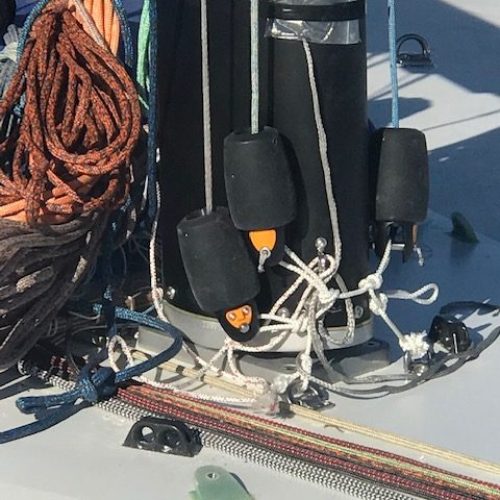
Eliminate halyard wear : With a hook, the halyard is no longer in tension and it is therefore the end of the halyards worn or broken by prolonged friction on one or more sheaves or by its jammer. On long cruises, you no longer have to worry about changing the position of the wear points : an obvious gain in serenity and real savings. Anyone who has been through the experience of a broken halyard, the fall and / or loss of a sail and the difficulty of ironing a new halyard will easily understand the value of the hook.
Remove the lengthening of the halyard. You will agree, the fabrics used for our sails are more and more technical (3DL, titanium, laminated racing : save weight (see first advantage) and avoid fabric deformation to obtain stability of the shape of the sail and thus improve performance. If you have invested in a technical sail you should understand that using a halyard that is too elastic will seriously reduce the benefits of your investment! The use of a good quality dyneema halyard is therefore compulsory. Better still, the use of a hook will avoid any deformation of the profile of the sail. This is an advantage highly sought after by sailors but it is far from being negligible on a cruising sailboat and even more so on heavy weather sails which usually work very poorly (complex implementation, not enough tension, halyard elastic,…)
Decrease halyard compression in the mast. It becomes more technical and not being an engineer, my explanation may be simplistic. If we imagine an average tension of 5 tons in the sail, this tension will necessarily apply to the mast but the direction of the forces will not be the same with or without a hook. A classic binding with a halyard compresses the mast more and tires it more. Thus, a mast originally designed for use with hooks will usually be subjected to less effort and it is therefore possible to use a less reinforced section, therefore lighter which brings us once again to our first advantage : weight gain.
A FEW TIPS
Tension from bottom : Since there is now a fixed point at the top, the only way to add tension to the sail is to be from the bottom.
This is an important point to think about when changing to adapt your fittings. If we take the example of a code 0, we usually fix the armor point to the bow then we hoist the sail with the halyard that we block with a jammer (installed on the mast or the piano). With a lock, you first hoist the sail to the lock point before taking the tension back through the weave point.
If you are using a furler, you will need to add a termination allowing the use of a hoist to have sufficient strength. It is usual to position the jammer that will block the tack point rope as close to the bow as possible to avoid the rope elasticity issues that we have sought to eliminate from the equation. Clamps that can be operated from the cockpit (such as our KJ clamps) are perfect to complete the setup.
Let’s say that the main constraint of a hook is that its installation cannot be improvised. The forces applied to the mast are different, the sizing of the ropes must be adapted, the fittings and its position are also different. We advise you to carry out this modification with a professional.
Maintenance & reliability : Locks don’t always get a good press, but that’s a very wrong judgment. Reliability has been there for many years and recent systems are very far from the mainsail locks of your Hobby Cat which regularly blocked. On the other hand, these are systems that require maintenance. Nothing very restrictive, but it is not imaginable to leave a lock “in its own juice” as we would do with a winch. You don’t need to hire a professional. Maintenance mainly consists of checking the state of wear and cleanliness of the parts.
DO I HAVE TO INSTALL ONE OR MORE HOOKS ?
If you are a racer and more particularly offshore racers, hooks are undoubtedly products that will help you improve performance. Chances are you already have them equipped unless your class’s gauge rules prohibit them. On an Imoca participating in the Vendée Globe, all the sails are hooked.
For occasional boaters, the financial and technical constraints are out of balance with the advantages. Nothing prevents having fun of course but it is quite rare to find hooks on a cruising sailboat that practices coastal navigation.
On the other hand, the hooks are particularly recommended on sailboats and almost essential on multihulls whose workloads can be very heavy. For these sailboats, the hooks are above all a guarantee of safety. All frequent travelers have had problems with halyards or reefing bumps that break in the middle of their trip. The hooks definitively solve this problem and significantly extend the life of the sails.
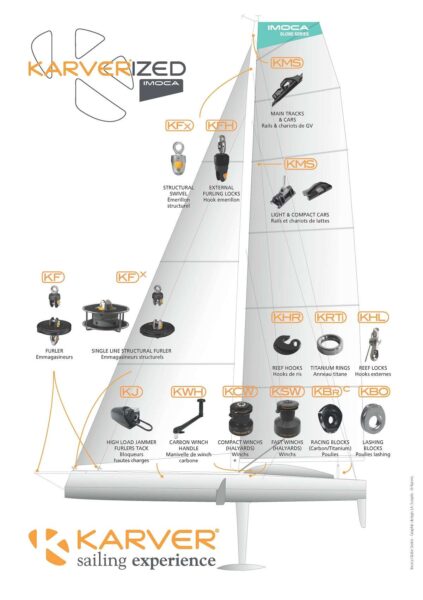

Concerned to provide fittings which bring more performance and/or of comfort and of safety, you will find in our range of numerous locks. Without going into the technical details, here is a tour of our solutions.
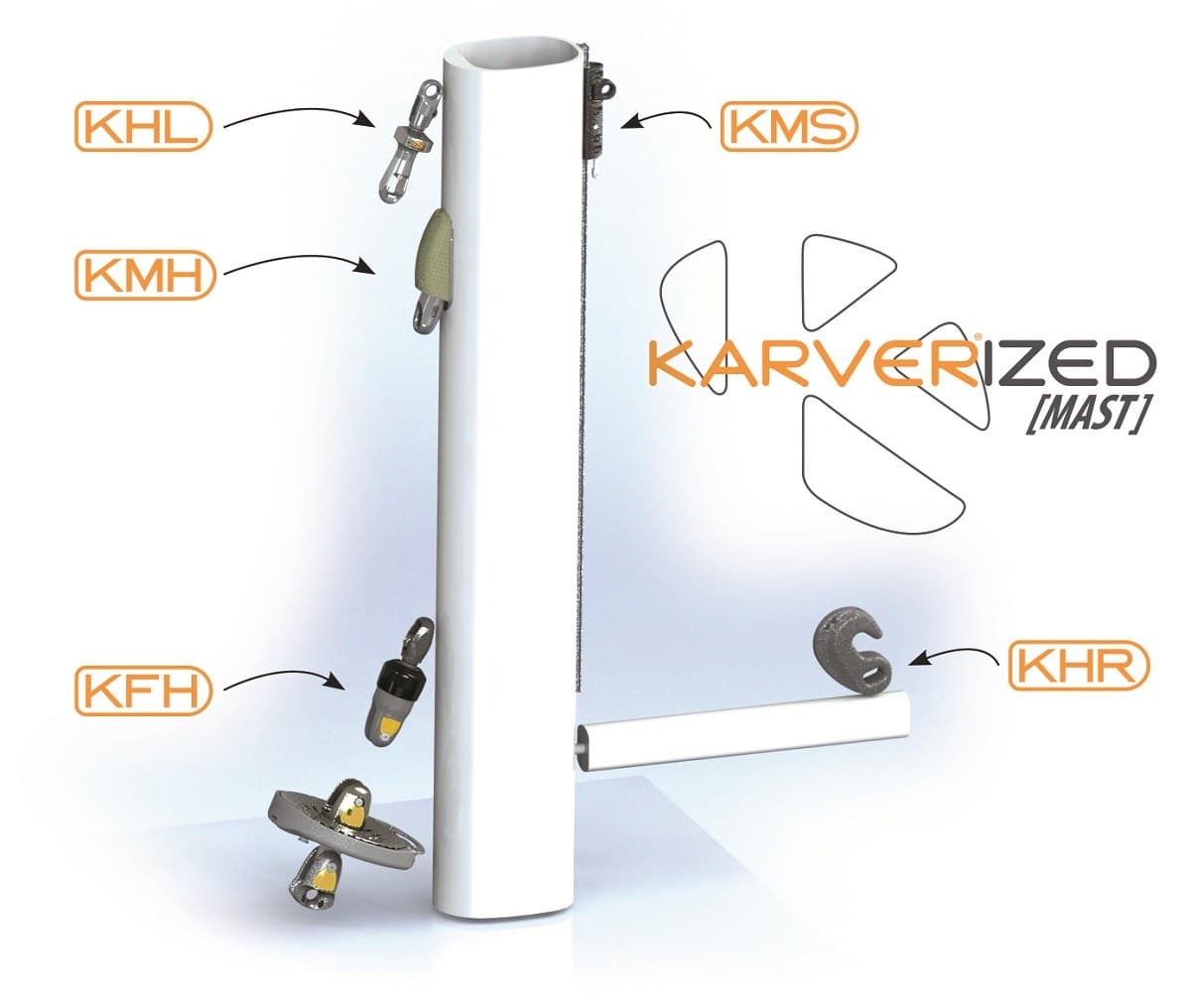
– Trolley of GV headstock hooked available on the ranges KMS40, 60, 80 and customs
– Fang of ris lock KHR to install on the boom
– Internal halyard hook at the mast KMH
– External halyard hook KHL
–External halyard hook with swivel KFH: it is a hook and a swivel in the same product dedicated to sails using a furler. It is the model that is the most used today on offshore racing sailboats (Ultim, Imoca, Multi 50, MOD70, Class40, ..)
-A blocker is not a hook, but our KJ blockers with 3 jaws are so effective that they bring some benefits of hooks, such as preventing the slippage of the rope.
Prices and availability of products vary depending on the delivery address.
Please select your country to adjust this information:
Prices and availability of products vary depending on the delivery address.
Please select your country to adjust this information:
: 1. Article one: Contract formation 1.1 Conflict between general terms and conditions of sale and general terms and conditions of purchase: The present general conditions of sale define the terms of execution and the conditions of sale between KARVER and its customers. To place an order implies a full and complete adhesion to the general conditions of sale described below. Sales are always made by mutual agreement between the parties as set forth below. These provisions cannot be modified by contrary stipulations contained in the general conditions of purchase of the customer or any other document without written agreement of the parts. 1.2. Consent: 1.2.1. Offer: Karver products’ offers accomplished by quotations can only be valid if they have been accepted in the indicated delay. All offer made by Karver will only become irrevocable after written confirmation by Karver to the client’s purchase order. 1.2.2. Acceptance: this can be done according to the forms and uses in force in commercial matters and in particular by mail, fax, telephone, internet or e-mail. 1.3. Cancellation: any request for cancellation of an order for any reason whatsoever may be examined only by payment of a cancellation indemnity set at fifteen percent (15%) of the net price excluding tax of the order. For custom orders, deposits will not be refunded. 2. Article two: Sold goods KARVER reserves the right to apply at any time any modification that it deems useful to its products without prior notice 3. Article three: Settlement terms 3.1. Terms of payment: The invoices are payable at the headquarters of KARVER Honfleur by credit card or wire transfer. 3.2. Payment period: 3.2.1. Principle of the will of the parties: The payment periods can be set freely by the parties but cannot exceed 60 days. 3.2.2. 30-day payment: The payment of KARVER products by customers who already have an account with KARVER is made on the thirtieth day following the date of receipt of the goods (Article L.144-6 of the French Commercial Code). 3.2.3. Special deadlines: Payment for Karver products ordered by new customers or customers who do not have an account with KARVER will be made in full payment before shipping. 3.3. Late payment penalties: 3.3.1. Methods of calculation: The sums not paid at the due date will result in the payment of monthly indemnities equal to 5 times the legal interest rate on the amount of the sum due, the payment of the totality of the remaining will stay due and deliveries will be suspended. In addition, a lump sum compensation for recovery costs of 40 euros is applied in accordance with Decree No. 2012-1115 of 2 October 2012 for any late payment over 10 days. 3.3.2. Late payment penalties are applied if the sums due are paid after the payment date shown on the invoice. Penalties are due without any reminder being necessary. They run automatically on the day following the date of payment on the invoice, or failing this, on the thirty-first day following the date of receipt of the goods. 3.4. Discount for upfront payments: There would be no additional discount for payment granted before shipping. 3.5. In the event of cessation of payment, bankruptcy filing, settlement or declaratory judgment against the client, the latter shall notify KARVER without delay so that an identification and an inventory of Karver products sold but not yet fully paid and cashed can be established and that the ownership clause can potentially be established. 3.6. In case of unpaid of all or part of a term, KARVER, without losing any of its rights may require the return of all products corresponding to orders not yet paid. 3.7. Karver may claim in the hands of the sub-purchasers the price or part of the price of products sold by Karver to the customer which have not been fully paid or cashed. In this case the customer agrees to provide any relevant information regarding to the sub-purchasers. 4. Article four: Price schedules, discounts and rebates 4.1. Prices: prices are “ex works”, packaging included, at the rate in force at the time of the order. Karver reserves the right to modify its rates according to currency fluctuations, raw materials or cost price. 5. Article five: Orders 5.1. The general conditions of sale apply to all sales, by signing the order, the customer accepts unconditionally the conditions of sale and waives any application of its General Conditions of Purchase. 5.2. Our orders are final from the moment they are confirmed in writing. Any modification can be taken into account only if it arrives in writing before the shipment of the products. In case of order modification our deadlines can be postponed. Similarly, if our buyer does not accept the change, the down payments will not be returned. 5.3. In case of late payment KARVER may suspend all outstanding orders without prejudice or any other actions. 6. Article six: Jurisdiction For all disputes relating to sales made by Karver and the application or interpretation of these Terms and Conditions of Sale, only the Commercial Court of Lisieux (France, 14) will be competent. 7. Article seven: Force Majeure KARVER is not liable in the event of fire, flood, interruption of supply of energy, raw materials or spare parts, as well as total or partial strikes of any kind impeding the smooth running of the company, such as transport strikes, postal services … The occurrence of a case of force majeure has the effect of suspending the execution of the contractual obligations of KARVER. 8. Article eight: OWNERSHIP RESERVE CLAUSE : 8.1. KARVER expressly reserves the ownership of the KARVER products delivered and designated in the sales contract until full payment of their price in principal and interest. 8.2. The goods will remain the property of KARVER until full payment of their price, but the buyer is responsible for them as soon as they are physically delivered, the transfer of possession entails the transfer of the risks as well. Signing this document, the buyer undertakes to subscribe an insurance contract guaranteeing the risk of loss, theft or destruction of the goods. 8.3. The transfer to the buyer, the disadvantages, the risks of loss or the deterioration of the products are subject to the retention of title. In case of application of the reserve of the property after the partial payment, the installments paid will be our property in counterpart of the depreciation undergone by the products. 9. Article nine: Delivery, receipt, returns 9.1. Receipt of products 9.1.1. KARVER deliveries are made by private carriers mandated by Karver at the expense of our customers. In the case of a carrier mandated by our customer, the goods will be transported at the expense and risk of it. 9.1.2. In case of apparent defect or failure the customer will have to make findings and reservations with his postal services on the transport receipt. 9.1.3. Deliveries can only be made if KARVER’s clients are up to date with their obligations. 9.1.4. Lateness cannot entail a cancellation of an order or any claim for damages. 9.1.5. All claims regarding apparent defective and non-conformity of products must be received within 8 days of delivery of the products. The client must then provide all the justifications on the reality of the defect and leave to KARVER any possibility to note the defect itself and to remedy it. 9.2. Delivery times Delivery times are given for information only and without guarantee. A delay does not entitle the buyer to cancel the sale, to refuse the goods or to receive damages. 9.3. Returns No return of Karver products can be made by the customer without the express written consent of KARVER. Returning costs will be borne by KARVER only in the event that an apparent defect is actually noted by the latter. Unless prior authorization, only the carrier chosen by KARVER is authorized to return the products concerned. 10. Article ten: The lack of conformity of the goods 10.1. The goods travel at the risk of the customer to whom it belongs to check the good condition at the time of delivery. This verification must relate to the quality, quantities and references of the goods and their conformity with the order. No claim will be taken into account after a period of fifteen days from the day of delivery. 10.2. Goods with a recognized defect of conformity, reported within 8 days, is subject to replacement or restoration, to the exclusion of any compensation, for any reason whatsoever. 11. Article eleven: Warranty Karver products are warranted for pre-sale defects making our material unsuitable for the intended use or which reduce such use so much that the buyer would not have acquired it or will not would have given a lower price if he had known them, in accordance with the provisions of articles 1641 and following of the civil code. The customer can only benefit from the guarantee if he notifies KARVER by registered letter as soon as possible. 11.1. Contractual Warranty: Karver products are warranted against defects in material or confection for a period of one (1) year from the date of delivery to the Professional Customers and two (2) years to the Private Customers from the date of sale. Under this warranty, the only obligation incumbent upon KARVER will be the free replacement or repair of the product or item found to be defective by its services to the exclusion of any other indemnity or damage and interest, the possible shipping costs being the responsibility of the customer. Defects and deteriorations caused by natural wear and tear, by an external event (product not adapted to real loads, assembly not conforming to the technical instructions of KARVER, defective maintenance, abnormal use or in competition …) or by a modification of the product not specified or specified by KARVER are excluded from the warranty. In the same way the guarantee will not play for the visible defects. 11.2. Legal guarantee: Under the guarantee of hidden defects, KARVER will only have to replace without charge the defective products excluding the repair of any other damage, shipping costs will be paid by the customer. 12. Article twelve: Use of the products Our buyers declare to have all the technical competences, to have taken note of our documentation to have been perfectly informed on the use, the handling, the dangers of the products and in case of doubts to appeal to one of our technicians. No other warranty than those contained in our documentation will be able to be declared to the customers. 13. Article thirteen: Custom, customized products: For professionals, our custom products are designed with their technical teams and meet the specific instructions that are communicated to them by them. Therefore, they are excluded from any warranty and their sale is made at the risk of the buyer who cannot, in particular, invoke a hidden defect. 14. Article fourteen : Spare parts: The duration of availability of our spare parts is at least 3 years from the date of purchase by the private customer. This indication is included in our user manuals.
Register our newsletter :