
SEARCH

RESELLERS

PRO


On an IMOCA, a Class40 or an Ocean Fifty, the furler does more than furl a sail. With the KFx Cunni, it also becomes a way to adjust sail shape, thanks to a tack that can be adjusted under load.
To understand the value of this system, first consider how some headsails are fitted on offshore racing boats. On IMOCA yachts in particular, the forestay is structural: it helps support the mast. For more than twenty years, this type of forestay has been made from high-performance textile fibres and fitted with a furler that rotates the forestay and sail together to furl the sail.
In a conventional arrangement, the sail is lashed directly to the swivel eye at the top and the drum eye at the bottom using several turns of high-strength line. It is light, simple and effective. But once the sail is fitted, the distance between its two ends is effectively fixed, leaving little room to adjust luff tension independently.
The luff is the leading edge of the sail, running from the tack at the bottom to the head at the top. A sail is not a flat sheet of cloth: it is a three-dimensional aerodynamic shape.
Luff tension affects the position of the draft and the shape of the sail’s entry. In general, more tension helps move the draft forward and hold the sail’s shape as the wind builds. Conversely, less tension can retain more fullness and flexibility in light air.
Sea state matters too. In flat water, a finer, more precise shape may be desirable. In rougher seas, a more forgiving setting can help the sail remain effective as the boat accelerates, slows and constantly changes angle slightly.

Moving the tack by a few millimetres does not simply raise the sail: it changes the tension along the entire luff.
This is the heart of the idea. The forestay must retain its structural role and its own tension. The sail, however, gains an additional adjustment. The KFx Cunni therefore acts on the sail’s tack without changing the structural role of the forestay.
The name “Cunni” naturally recalls the Cunningham: on a mainsail, that adjustment also changes luff tension. Here, the principle is applied to a headsail furled around a structural forestay.
The forestay still supports the mast and the furler still furls the sail, but the sail’s tack becomes adjustable.
Because an IMOCA or an Ocean Fifty can encounter very different wind strengths, points of sail and sea states within a few hours. Performance depends less on one “perfect” setting than on the ability to adapt the boat quickly to the conditions.
Making luff tension independent gives the sailor another adjustment, alongside forestay tension, sheet position and sail twist. Several equipment makers have developed solutions with the same aim, reflecting a real technical need in modern racing.
The mechanical principle is fairly simple: the furler drum can slide axially on the rotating part. The assembly still rotates to furl the sail, but it can also move vertically to adjust the tack.
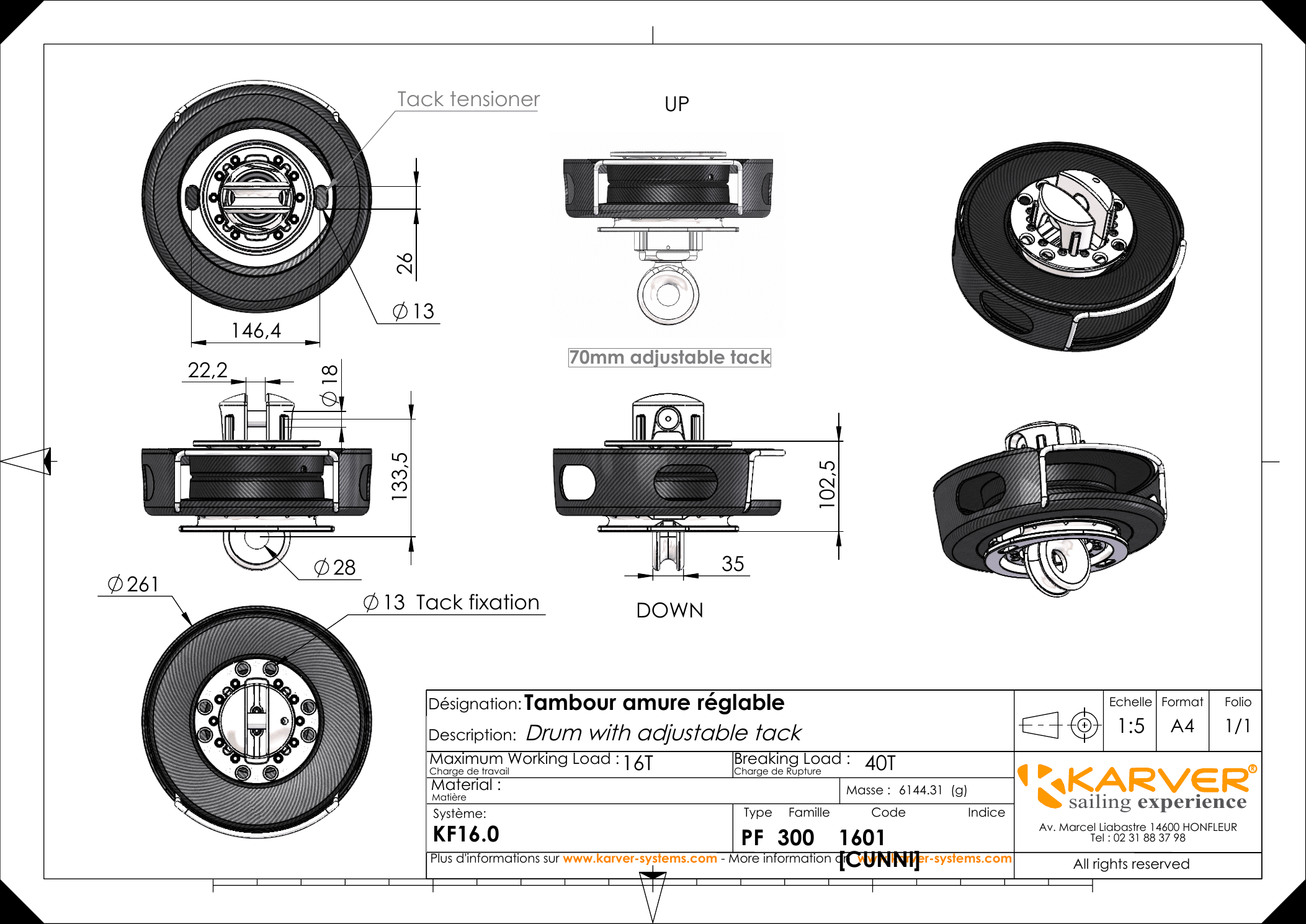
Karver models currently available:
A cruising sailor does not need every adjustment found on an IMOCA. But the principle is universal: no sail has one ideal shape for every condition. Wind, sea state and point of sail change; finer control over the sail’s shape helps adapt the boat.
The KFx Cunni illustrates a broader development in modern deck hardware: it does more than support or manoeuvre a sail; it also helps control its shape more precisely. It is a practical example of what offshore racing can bring to cruising: separate functions, refine adjustments and give the sailor greater control.

Author: Marin Clausin (September 2026)
Would you like to react to, comment on or share this article with its author? Email Marin Clausin.
Find more technical articles in the KarverPedia section of our website.
More from KarverPedia:
